
In a world that idealizes perfection, it’s very hard to start loving yourself, with the incredibly difficult, expensive, time-consuming, and in many cases, unattainable standards for beauty and lifestyle. Not to mention, there’s the push to be physically healthy, socially acceptable, financially sustained, environmentally friendly, have a work/life balance, and succeed in our mental and emotional wellbeing!
My name is Erin, and I am an intern here at Dóchas Psychological Services in Spruce Grove. I’d love to discuss some of the mechanisms behind self-compassion to practice loving ourselves in a way that can benefit personal, relational, and social aspects of our lives to improve our overall well-being.
Before I begin this spiel, I want to clear up a few things:
- You are beautiful and as perfectly imperfect as the person next to you.
- We all have trouble accepting ourselves entirely.
- If at first you don’t succeed, try, then try again.
- There are resources available to support you if this topic is distressing to you or if you would like more information. Please reach out to info@dochaspsych.com or call 1-877-303-2642 for the Alberta Health Services Mental Health Help Line if you’re in need of immediate support.
Watch my video, or read on for more details:
Why Do You Feel Like You’re Not Enough?
I see a lot of positive trends on social media and in mental health campaigns that promote self-care, body positivity, social inclusivity, environmental responsibility, and financial freedom, which can be a bit overwhelming for those of us just trying to keep our heads above water.
It is also difficult to feel motivated to meet standards when the same media sources flood our feeds with conflicting advertisements filled with “ideal” body expectations, high-brow lifestyles, fitness gurus, and “get rich quick” schemes. This overwhelming flood of opposing information can lead to symptoms of distress like racing thoughts, anxiety, depressed mood, avoidance of people and social situations, negative self-valuation, and other negative feelings that make us feel like we are not meeting the mark.
If this feels familiar, you are not alone!
What is Self-Compassion?
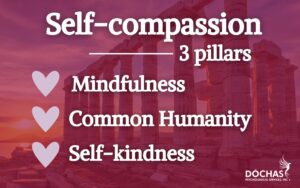
Self compassion is the concept of developing a positive, loving relationship with yourself ,and is built using three components:
Mindfulness: Listening to the emotions and feelings you are experiencing with curiosity rather than judgment.
- Notice your emotions and feelings to moderate media and outside information to promote positive responses rather than those that cause distress.
- Listen to your thoughts to make sure you are not being mean or negative to yourself. Negative self talk can be replaced by positive affirmations to reflect our desire to build a healthy relationship with ourselves.
- Remember to be kind to yourself to avoid judgment.
Common Humanity: Exploring your feelings and emotions in connection to the greater human experience
- Look at others in your life and examine their similar experiences to note the common struggle we all face as individuals.
- Forgive any mistakes, setbacks, and challenges you face and reframe these thoughts to look at them as learning experiences that are helping you build the skills you need.
- Allow yourself to grow and change even if it is scary. Change allows us to build and improve on things that are not beneficial to our wellbeing.
Self-Kindness: Being gentle and understanding of your own experiences.
- Allowing kind and positive self-talk to help you learn to accept and love yourself for the effort and resilience you have shown.
- Stand back and ask yourself how you would treat your best friend if they needed comfort in the same situation.
- Positive affirmations and gratitude, either out loud, by journalling, or as internal dialogues to promote self-worth.
Why Should You Focus on Loving Yourself?
Individuals that practice self-compassion experience improve psychological health, less anxiety, stress, and depression symptoms, and more resilient coping in times of crisis. Having a healthy and loving relationship with yourself has also been found to improve how we relate and engage in our relationships with others to build more attached, understanding, and supportive interactions with those we love.
Self-compassion differs from self-esteem in that it does not require us to judge and compare ourselves with others, but rather allows us to learn to accept and love ourselves regardless of our differences.
Building a Loving Relationship with Yourself
Awareness is the first step to loving yourself and it may take some time to learn to love and accept yourself for all your perfect imperfections. This will require time, forgiveness, patience, and extra kindness to yourself as you build some of these skills, but it is worth the time and effort to convince yourself that you are normal, and better yet, that you are enough.
If you need some help being more self-compassionate, please reach out to Dóchas at 780-446-0300 or info@dochaspsych.com. Book an in-person (Spruce Grove, Alberta) or virtual appointment with one of our therapists here.
References
Morris, K. L. (2025). Self-Compassion Through a Relational Lens: An Analysis of How the Rewards Extend Beyond the Individual. American Journal of Family Therapy, 53(3), 319–345. https://doi.org/10.1080/01926187.2024.2434849
Rosenthal, S. R., & Tobin, A. P. (2023). Self-esteem only goes so far: the moderating effect of social media screen time on self-esteem and depressive symptoms. Behaviour & Information Technology, 42(15), 2688–2695. https://doi.org/10.1080/0144929X.2022.2139759
About Dóchas Psychological
Dóchas Psychological Services is a well-established and trusted therapy clinic located in Spruce Grove, Alberta. At Dóchas we value the idea that everyone deserves a safe space. Through connection and education, our team works hard to build a trustworthy relationship with each of our clients. It is our goal to create a community for our clients to feel like they belong.
Disclaimer
Information provided through Dóchas Psychological Services blogs or vlogs is meant for educational purposes only. They are NOT medical or mental health advice. You can read more about our disclaimer here.