

Hi everyone, it’s Brittany on the blog today. I wanted to explore a topic that is recurring for many of my clients. Recently, there has been a lot of talk on social media about “attachment” and “attachment styles”. These posts may have you thinking about times where you pulled away when someone got too close, or times you became fearful that your partner would leave you.
Attachment styles are rooted in early childhood relationships. These styles are internal blueprints that shape how we relate to others, in particular our close, romantic, and emotionally vulnerable relationships.
Keep reading or watch my video for more information!
What are Attachment Styles?
Attachment styles reflect how safe and secure we feel in emotional connections. They are shaped by the experiences we had with our caregivers growing up, BUT they are not set in stone. Life experiences, self-reflection and healthy relationships can reshape them.
There are four primary attachment styles:
- Secure
- Anxious (Preoccupied)
- Avoidant (Dismissive-Avoidant)
- Disorganized (Fearful-Avoidant)
>Secure Attachment
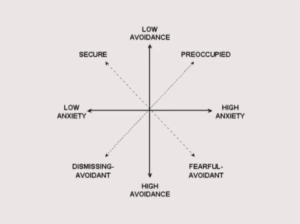
Secure attachment is characterized by a person feeling trusting and comfortable with intimacy and space (Raypole, 2022). This is a low avoidance and low anxiety attachment.
>Anxious Attachment
In an anxious or preoccupied attachment, a person may have a strong desire to be intimate, but fear abandonment (Raypole, 2022). In this attachment style, there is high anxiety and low avoidance.
>Avoidant Attachment
Avoidant or dismissive-avoidant attachment involves independence and a decrease in the need for intimacy or closeness (Raypole, 2022). Avoidant attachment is low in anxiety and high in avoidance.
>Disorganized Attachment
Lastly, someone who has disorganized or fearful avoidant attachment may have an internal conflict, wanting closeness, but fearing getting too close to the person (Raypole, 2022). In this attachment style, there is high anxiety and high avoidance.
(Fraley, n.d.)
Why Attachment Styles Matter
Understanding your attachment style can help with your overall understanding of your emotional world. It can help provide answers to questions regarding relationships, emotions and conflict.
When we gain awareness of these patterns, we become more empowered!
Can Attachment Styles Change?
YES! While early experiences matter, therapy, self-reflection, supportive relationships and emotional healing can help move toward greater security.
One way which we can help foster change is by increasing our self awareness. This can be done by becoming aware of our triggers and our responses in moments of stress or anxiety. We can also practice regulating our emotions. By learning to pause, breathe, and then respond, we are able to better respond to fear or difficult situations. Lastly, building a safety net by seeking out (or becoming) someone who offers an emotional presence, honesty and consistency, can help with our ability to change and grow.
Conclusion
Our attachment style doesn’t define us; it just shows us where we’ve been. Whatever your style is, the path to healing and secure attachment begins with compassion for yourself and for the parts of you that have learned to love and connect in particular ways.
We all want to feel seen, safe and loved, because that’s what makes us human.
Healing happens in safe relationships, whether with a partner, therapist, or even with ourselves.
If you’d like to explore this topic with a therapist, please feel free to reach out to Dóchas at 780-446-0300 or info@dochaspsych.com. Book an in-person (Spruce Grove) or virtual (across Alberta) appointment with one of our therapists here.
References
Levy, T. (2024, July 8). Four styles. Evergreen Psychotherapy Center. Retrieved July 2025, from evergreenpsychotherapycenter.com
Cherry, K. (2020, June 4). 4 types. Verywell Mind. Retrieved July 2025, from https://www.verywellmind.com
Fraley, R. C. (n.d.). Information on attach. theory and research. University of Illinois at Urbana-Champaign. https://labs.psychology.illinois.edu/
Raypole, C. (2022, July 28). Anxious style: Signs and how to cope. Psych Central. https://psychcentral.com/
About Dóchas Psychological
Dóchas Psychological Services is a well-established and trusted therapy clinic located in Spruce Grove, Alberta. At Dóchas we value the idea that everyone deserves a safe space. Through connection and education, our team works hard to build a trustworthy relationship with each of our clients. It is our goal to create a community for our clients to feel like they belong.
Disclaimer
Information provided through Dóchas Psychological Services blogs or vlogs is meant for educational purposes only. They are NOT medical or mental health advice. You can read more about our disclaimer here.