


Have you ever tried meditating and felt like you were doing it completely wrong?
Maybe you pictured a perfectly serene monk, sitting cross-legged on a mountaintop with an empty mind and no distractions. Then you closed your eyes and, within seconds, your grocery list, your email inbox, and that thing you said in 2016 all came rushing in. You opened your eyes and thought, “I’m just bad at meditating. Maybe meditation isn’t for me.”
The truth is that a lot of what people know about meditation is based on misconceptions. These misconceptions can actually get in the way of experiencing the real benefits meditation has to offer.
It’s Aurianna here, and today I will clear up some of these misconceptions and explore how meditation might support your mental and emotional well-being, even (especially!) if you don’t feel like a monk on a mountaintop.
Misconception #1: There’s Only One Type of Meditation
Some people might talk about “meditation” as though it is a single practice, but in fact there are many different types of meditation originating from many different traditions, and each of them has unique goals and practices. This blog will focus on mindfulness meditation, which originates from Buddhist traditions, but has been widely utilized in therapeutic and other contexts.
Mindfulness meditation is considered a foundational practice, and great for beginners because it’s simple and helps build the skills necessary to focus the mind.
Misconception #2: Meditation Is Meant to “Clear Your Mind”
You’ve probably seen it in movies: a stressed-out character is told to “clear your mind” by a wise mentor, and one meditation later, they’re floating in a peaceful void of serenity. But in real life, minds don’t work like that.
The goal of most meditation practices isn’t to empty your mind of thoughts. Instead, the goal is to observe and focus your mind. This is a subtle but powerful difference.
So, what does it mean to focus the mind?
Many meditation styles involve choosing a point of focus, often the breath, and returning your attention to it whenever your mind wanders. This point of focus is sometimes called an anchor.
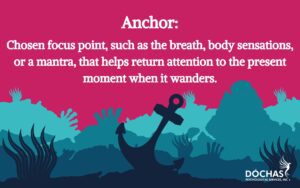
An anchor is something steady you can return to when your thoughts pull you away. It could be:
- The feeling of your breath moving in and out
- The sensation of your feet touching the ground, or an object in your hand
- A sound, like a mantra or bell
- A visual object, like a candle flame
Let’s say you choose your breath as the anchor. You begin by simply noticing how it feels to inhale and exhale. Then a thought pops in: “Did I reply to that email?” You notice you’ve been pulled away, and you gently guide your attention back to your breath.
That process, the wandering, noticing, and returning to the anchor, is the heart of mindfulness meditation. Over time, this trains the brain to improve focus, reduce reactivity, and regulate emotions with more ease. Repeatedly returning your focus to the anchor strengthens your attention and awareness just like how lifting weights builds physical strength.
Misconception #3: Meditation Is About Being Calm or Detached
Another common misunderstanding is that meditation is about staying calm, caring less, or becoming emotionally detached.
But meditation is really about sitting with your emotions, especially the uncomfortable ones, without immediately reacting, avoiding, or judging them. Some styles of meditation even use specific techniques to surge the intensity of emotions for spiritual or self-reflective purposes.
Most of us are taught to manage our emotions in one of two ways:
Acting them out (yelling when we’re angry, or withdrawing when we’re sad), or pushing them down (pretending we’re fine, staying busy, or numbing out).
Meditation creates a space where emotions are allowed to simply exist. You don’t have to change them, fix them, or get rid of them, you just notice them.
A wave of sadness may come. You observe it.
A surge of anxiety may arise. You notice it, without trying to escape or distract yourself.
Some experienced meditation teachers even believe that emotions carry important wisdom, and that within discomfort lies insight, if you’re able to stay long enough to listen. Further, being able to stay with your own difficult emotions can allow you to stay with others through their difficult times, without feeling the need to act out or push away the emotions of others, which can strengthen your relationships.
Misconception #4: You Should Be Sitting Perfectly Still When Meditating
You also don’t have to sit in any particular way, or sit perfectly still. Finding stillness in the body is one practice that works for some people, but everyone is different.
You can try a variety of positions, and if you feel the need to change position, rock, stretch, or fidget, that is okay. Simply notice the urge to move or change, and be intentional in your choice. Notice what it feels like to resist the urge to change. Then notice what it feels like to change. The whole point is to notice.
Some people even choose to do a walking meditation. A common phrase is, “if you can’t sit with it, walk with it.”
Walking may be easier if you are experiencing intense emotions, or for those who find themselves too restless or sleepy in sitting meditation. The concept is still the same: choose an anchor, notice when you wander, and return as soon as you notice you’ve strayed.
Misconception #5: “I’m Just Bad at Meditating”
This is probably the most common thing I hear people say when they struggle with meditation: “I can’t focus. My mind won’t stop wandering. I must be bad at this.”
But what if that wandering is the whole practice? There is no such thing as a “bad” meditation. If you sit down, close your eyes, and your brain starts playing a highlight reel of your entire week, that’s okay. Every time you catch your mind wandering and gently guide it back, you’re practicing mindfulness.
You might be surprised, confused, annoyed, or bored by the type of thoughts that come up, but I want you to notice these feelings. You’re building self-awareness!
Final Thoughts: How Can Meditation Help?
Even in small amounts, meditation can:
- Improve focus and attention
- Build emotional resilience
- Reduce stress and reactivity
- Help you feel more present in your daily life
- Support healing by allowing emotions to be felt and processed
Most importantly, meditation can help you learn to be present with yourself just as you are.
If you’d like support in beginning or deepening your meditation practice, feel free to reach out to Dóchas at 780-446-0300 or info@dochaspsych.com. Book an in-person (Spruce Grove) or virtual (across Alberta) appointment with one of our therapists here. Book a FREE 15 minute consult with Aurianna here.
About Dóchas Psychological
Dóchas Psychological Services is a well-established and trusted therapy clinic located in Spruce Grove, Alberta. At Dóchas we value the idea that everyone deserves a safe space. Through connection and education, our team works hard to build a trustworthy relationship with each of our clients. It is our goal to create a community for our clients to feel like they belong.
Disclaimer
Information provided through Dóchas Psychological Services blogs or vlogs is meant for educational purposes only. They are NOT medical or mental health advice. You can read more about our disclaimer here.